For the seventh year in a row, TrustArc surveyed professionals around the world, scoring them according to their companies’ privacy performance on a Global Privacy Index. Take a peek at the headlines from 2026’s Global Privacy Benchmarks.
The Global Privacy Index dropped to 53% in 2026, down from 61% in 2025. While the top third held steady above 75%, a significant share of mid-tier programs slipped into the failing range — now 38% of organizations, up from 24% the prior year.
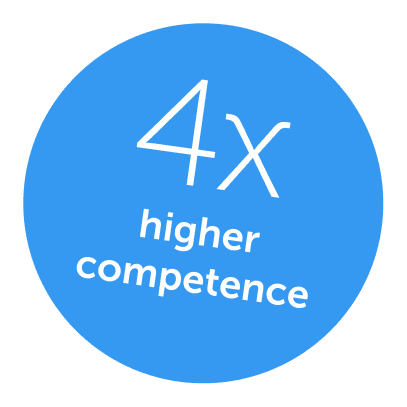
Six initiatives yields 4X the competence.
As organizations implement key initiatives — data inventory, consent management, DSR management, Trust Centers, and others — Global Privacy Index scores rise from 18% to 85%. Those with interoperable technology and six or more initiatives average 75%, nearly four times the competence of fragmented programs.
Compliance is the floor, not the ceiling.
Programs delivering value only at the compliance level show almost no measurable competence. Predicted Index scores rise to 29% with operational efficiency gains, 61% when customer trust is strengthened, and 90% when value spans all four ROI layers — including innovation and future-ready operations.
AI problems are up 7 points — is your governance?
69% of respondents use AI tools often or very often at work. 24% report problems from AI-driven decisions in the past three years, up seven points from 2025. Preparedness is improving — 72% feel ready for EU AI Act enforcement (up from 61%), and 66% for the Colorado AI Act (up from 57%).
Frameworks: the 20-point advantage no one’s talking about.
Organizations aligned with governance and accountability frameworks score 70%–76% on the Global Privacy Index — roughly 20 points above average. Those without certifications and with siloed systems score as low as −12%.
One of the clearest findings in the 2026 Global Privacy Benchmarks is that technology integration and operational breadth don’t just improve privacy programs, they transform them.
As organizations implement key privacy initiatives — data inventory, consent management, DSR management, Trust Centers, and others — Global Privacy Index scores rise steadily from 18% to 85%. Most organizations need about five fully implemented initiatives to reach baseline maturity. But the real leap happens when those initiatives are backed by an integrated, interoperable technology stack.
Fragmented Program
Average GPI Score
~0%
Siloed, manual processes
GRC tools adapted for privacy
Reactive compliance posture
≤ 5 initiatives fully implemented
Integrated Leader
Average GPI Score
~0%
Purpose-built privacy platform
Fully integrated tech stack
Principles-based governance
6+ initiatives fully implemented
The data draws a sharp contrast. Fragmented programs — siloed manual processes, GRC tools adapted for privacy, a reactive compliance posture, and five or fewer initiatives — average just 21% on the Global Privacy Index. Integrated leaders, operating purpose-built platforms, fully connected tech stacks, principles-based governance, and six or more initiatives, average 75%. That’s nearly four times the competence.
The tech stack matters too. Organizations using purpose-built privacy management software are significantly more likely to operate fully integrated environments than those relying on GRC platforms, which more often produce fragmented, multi-vendor stacks.
Operational breadth and technology integration reinforce each other — and organizations that invest in both build fundamentally more capable privacy programs.
AI and Privacy
More Deployment, Stronger Governance, Continued Challenges
AI has moved well beyond experimentation. In 2026, 69% of respondents use AI tools often or very often, and 74% say leadership is actively pushing to expand deployment — up from 66% in 2025. For privacy teams, that means governing a technology evolving faster than the frameworks designed to manage it.
The challenges are structural: rapidly changing technology (44%), technical complexity (39%), and unclear regulatory requirements (32%) make it difficult to apply traditional privacy controls to AI systems operating at scale.
Yet governance is catching up. 76% of respondents are confident in their ability to adapt privacy practices to emerging AI regulations, and that confidence is backed by improving preparedness scores. Readiness for the EU AI Act rose to 72% (up from 61%), and Colorado AI Act preparedness climbed from 57% to 66%.
Adoption is accelerating and risks are growing — organizations that invest in AI governance infrastructure now, rather than waiting for regulatory pressure, will be the ones setting the pace.
Are you a leader or a laggard?
Find out more about how companies stack up. Fill out the form to download the Global Privacy Benchmarks.
About TrustArc
TrustArc is redefining privacy for the AI era. With 28+ years of global privacy expertise and assurance services, we deliver the only platform that blends regulatory intelligence, automation, and AI to orchestrate end-to-end data privacy and governance. From automated DSR fulfillment to AI risk assessments and real-time compliance reporting, TrustArc helps organizations embed trust at every touchpoint. Headquartered in the San Francisco Bay Area with a global footprint, our privacy-first approach powers responsible innovation while reducing risk, ensuring our customers lead with confidence in a rapidly evolving regulatory landscape. Discover how at TrustArc.com.
About Golfdale Consulting
Golfdale Consulting Inc., trusted advisors to growth-focused business leaders. Golfdale expertise spans three critical areas: global market research and insights, analytics strategies and application of decision sciences, and advocacy for evidence-based regulatory reform and market impact.